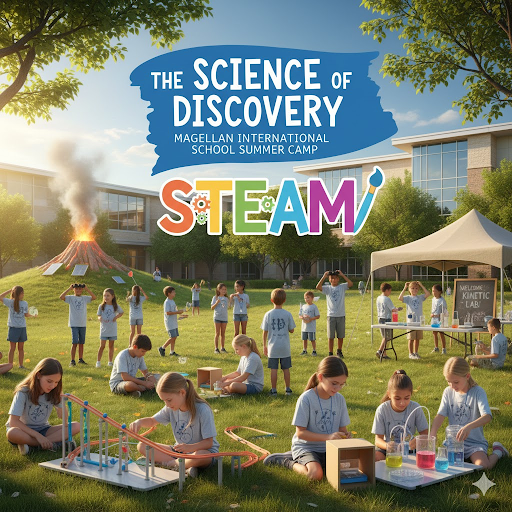
Welcome to Artful+ STEAM Camps, presented by Magellan’s primary science teacher, Ms. Blancanela Miles.
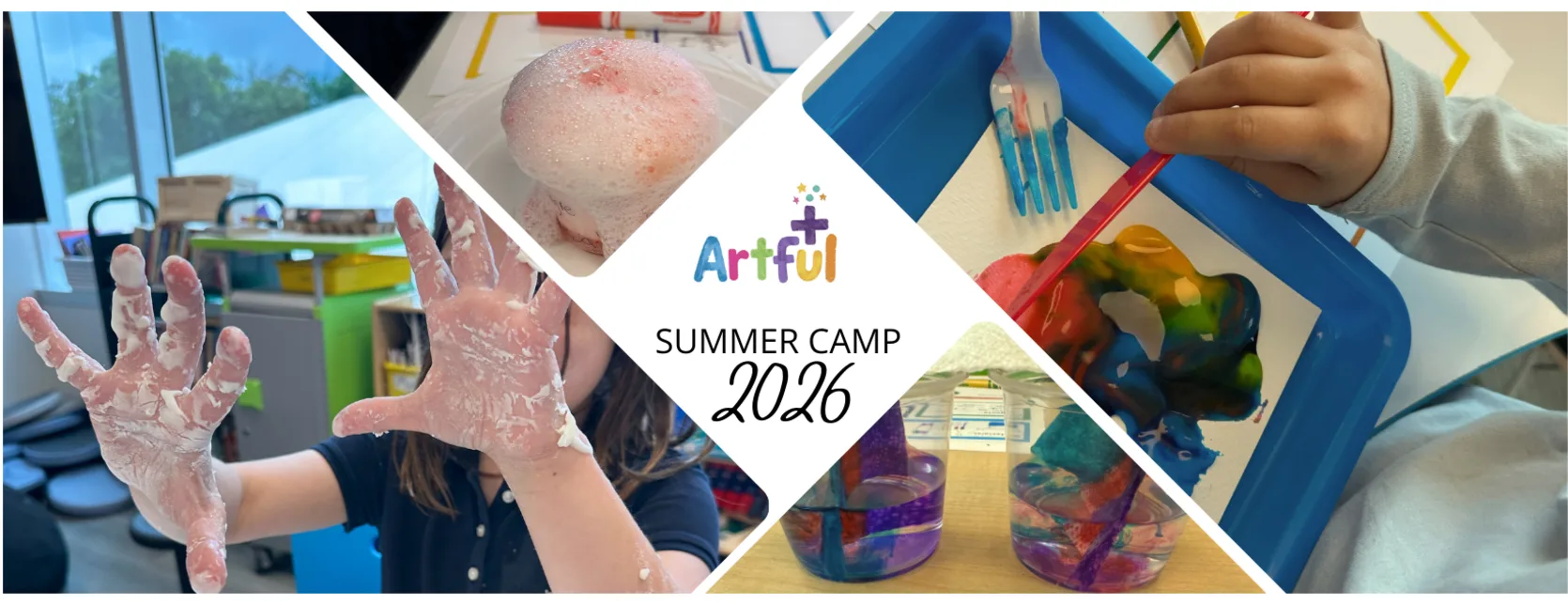
Water, Weather & Motion: Children explore water, wind, and weather through hands-on art, science, and math experiences. Through fluid art, wind-powered painting, and playful experiments, they investigate how movement and natural forces shape our world. As they create and explore, children practice key math skills such as measurement, comparison, and estimation—while building curiosity, creativity, and a deeper understanding of nature through joyful, experiential learning.
Big Inventions: How do art, science, technology, and math shape the world’s greatest inventions? During this week, campers step into the role of young inventors, discovering how creativity and problem-solving have driven innovation throughout history. Children will learn about famous inventors and visionaries—such as Leonardo da Vinci, Thomas Edison, Nikola Tesla, and the Wright brothers—and explore how curiosity, experimentation, and perseverance led to their groundbreaking ideas. Inspired by these innovators, campers will design and test paper airplanes, build simple circuits, create cars using recyclable materials, and invent their own original creations through hands-on engineering challenges. Along the way, they will apply mathematical thinking, measurement, and basic physics concepts while learning that mistakes are an important part of the invention process. This week empowers children to think like inventors—asking questions, testing ideas, learning from failure, collaborating with others, and proudly sharing their solutions—while building confidence, creativity, and a love for innovation.
History: Art, Science, and Math Through Time: Students will travel through time to discover how art, science, and math have shaped human history. From ancient civilizations to modern innovators, children will explore how people across different eras used creativity and problem-solving to understand and improve their world. We will begin in Ancient Egypt and Rome, where students will build pyramid models, explore symmetry and measurement, and learn how engineering and mathematics were used to create temples, roads, and monuments that still inspire us today. As we move through history, students will discover brilliant minds who blended art and science, such as Leonardo da Vinci, exploring his inventions, sketches, and curiosity about how things work. They will design their own machines inspired by his ideas.
Children will also explore artists who changed the way we see the world:
Pablo Picasso, learning how shapes and geometry can tell stories
Wassily Kandinsky, discovering how colors, patterns, and music connect
Alexander Calder, creating balance through moving sculptures
Cruz-Diez, experimenting with color, movement, and optical effects
Throughout the week, students will create hands-on projects that combine history, design, engineering, and math, helping them understand that innovation comes from curiosity, experimentation, and imagination. This week invites children to see themselves as young historians, artists, engineers, and inventors, discovering how ideas from the past continue to inspire the future.